






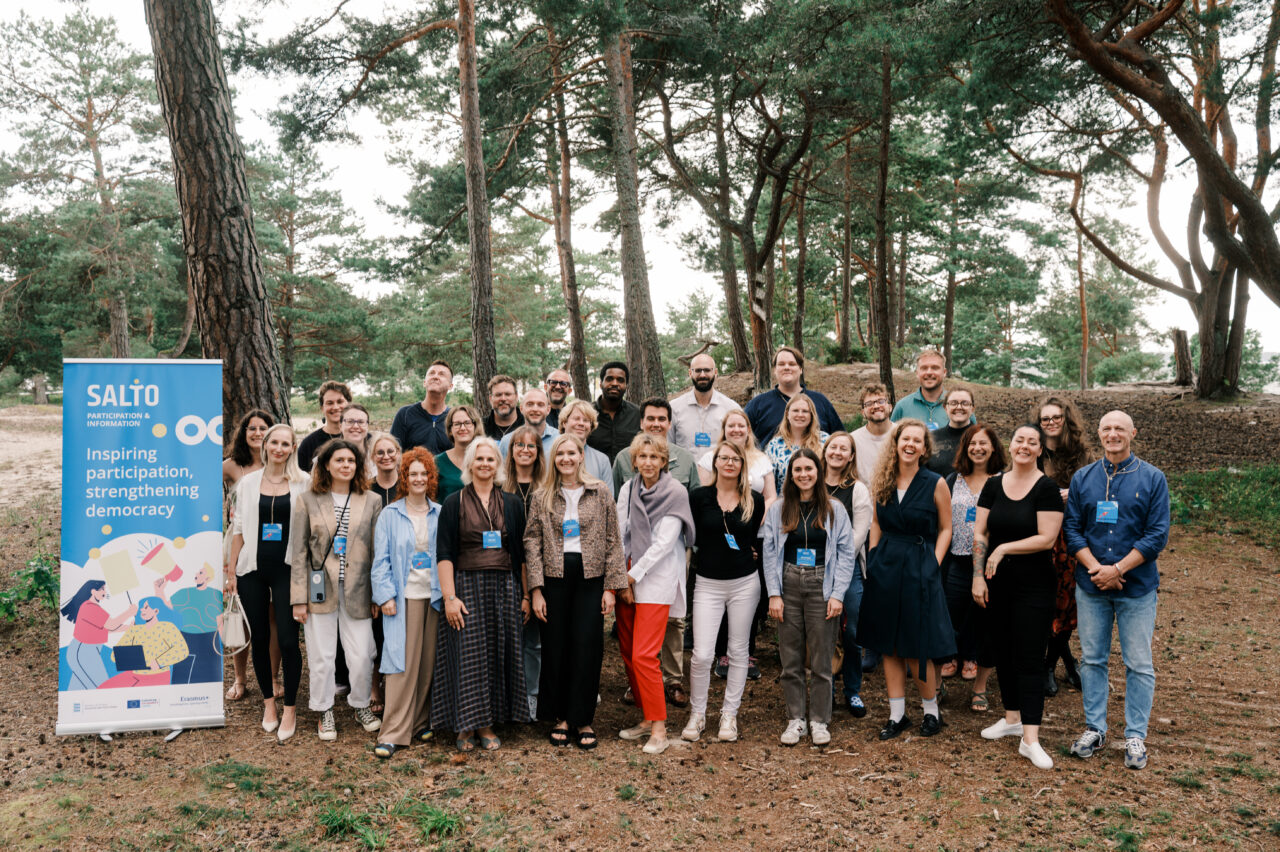
Foto autor: Rene Riisalu
The SALTO Participation and Information Resource Centre (SALTO PI) brought together 28 participants – experts, National Agency staff, researchers, youth representatives and civil society representatives – for a three-day Consultative Meeting in Laulasmaa, Estonia, on 6–8 August 2025. The aim was to design and co-shape its Action Plan for 2026–2027. The meeting reflected SALTO PI’s core principle of participatory planning: “nothing about us without us.”
The goal of the meeting was to embody and promote participatory principles in SALTO PI’s work by ensuring that the activities, plans, and support offered are directly aligned with the real needs of target groups.
The Consultative meeting gathered participants from across Europe – from Erasmus+ National Agencies in both Youth and Education & Training, to umbrella organisations, policy experts and youth representatives. Using participatory methods such as world café discussions, visual mapping and co-creation groups, the meeting ensured that perspectives from practice, policy and research all fed into the outcomes and SALTO PI’s next work plan is getting necessary insights from stakeholders.
What encouraged us most was the clear feedback that our activities and developments so far have been appreciated, and that we should continue in this course. This shows we are very much on the same page with our stakeholders. We want to sincerely thank the umbrella organisations, civil society actors, experts, and young people who have helped us widen our perspective beyond the ‘bubble’ of Erasmus+ and the European Solidarity Corps. Nurturing and strengthening these collaborations will remain a priority also in the future,” said Regina Rähn, the Team Lead of SALTO PI.
Ten priorities for SALTO PI’s next work plan
Participants agreed on ten thematic recommendations to guide SALTO PI’s next strategic cycle:
- Tailor support for National Agencies with training, peer learning and context-specific guidelines, moving away from a one-size-fits-all approach.
- Consolidate and rationalise tools to avoid duplication, focusing on quality, usability and multilingual adaptability.
- Upgrade the Participation Pool into a one-stop hub with success stories, filters, and user-tested features.
- Strengthen monitoring and evidence, combining qualitative and quantitative indicators and publishing an annual State of Participation Report.
- Integrate the Youth Participation Strategy (YPS) more firmly into National Agency work and decision-making, with continued Steering Group support.
- Promote cross-sectoral cooperation between youth, education, training and civil society.
- Simplify communication and outreach, highlighting real-life participation stories and offering ready-to-use materials for National Agencies.
- Reimagine the Participation Forum 2026/2027 as a strategic engine with concrete outcomes, diverse voices and innovative participatory formats.
- Invest in capacity building by working with the European Commission to make participation an explicit priority in programme structures — including funding criteria, accreditation, financial instruments, and evaluation.
- Embed a participatory culture across all work, from recruitment of trainers to piloting new models of co-creation with young people.
Concrete recommendations and concrete action
Alongside strategic priorities, participants also gave concrete recommendations for improving SALTO PI’s existing tools and activities. They called for the Participation Resource Pool to be upgraded into a multilingual, user-tested hub offering filters, case studies and practical resources.
A unified monitoring and evidence framework was proposed, with shorter youth-friendly surveys and an annual State of Participation Report.
The Youth Participation Strategy should be more firmly embedded into National Agencies’ daily work, with stronger steering structures and real power-sharing with young people.
The Participation Forum was seen as needing a stronger role, reimagined as a strategic space that brings together diverse actors, uses innovative formats and ensures clear follow-up actions.
“Many of the suggestions we received are already planned, underway, or even implemented. For example, the new version of the Participation Resource Pool is now in its final stages and will be launched soon. It has been redesigned to also address the needs of the formal education field, building on the existing resources developed for the non-formal education sector. The Participation Network of National Agencies is functioning well, and the next step will be to further develop context-specific support. We will also continue to promote peer-to-peer learning. The Youth Participation Steering Group has been very active in advancing the Youth Participation Strategy, and we continue focusing more concretely on Strategic Aim 5, which addresses involvement, and Aim 6, which places inclusion at the core. This will help us maintain a clear direction,” commented Rähn on the progress.
“Of course, it is not possible to realise all good ideas within our current resources. For instance, a full translation of the Participation Resource Pool into all languages is beyond our budget. However, the Google plugin allows access in other languages, and key resources can also be filtered by language. We warmly welcome any high-quality materials on participation that connect to Erasmus+, the European Solidarity Corps, and participation in democratic life,” she added.